Handing Down the Precious Sword (7-10)
(Bản dịch Anh ngữ : GƯƠM BÁU TRAO TAY)
 Ghi chú: Theo yêu cầu của một số bạn ở xa muốn có đầy đủ bản dịch Anh ngữ cuốn GƯƠM BÁU TRAO TAY (viết về Kinh Kim Cang) này, tôi xin post lên đây chương 7-10 là trọn bộ.
Mong các bạn khi đọc có ý kiến gì vui lòng đóng góp cho.
Trân trọng,
Đỗ Hồng Ngọc
7. Facing phenomena with empty mind
Let’s go back to Subhuti. After having required the name of the Sutra, shed some sorrowful tears, regretfully lamenting that the deep teaching had been revealed to him only now even though he had followed the Buddha for so many years, he suddenly stood up and repeated his first question: “How to quiet, how to subdue one’s mind”, as if he did not hear anything since the beginning. How curious! Could he possibly be that forgetful or already… in his dotage? The amazing thing is that not only he did not receive any dressing down by the Buddha “don’t you speak like that!”, but the World Honoured answered him even more affably! There must be some riddles here!
Maybe it was not without reason that the Buddha had chosen Subhuti to expound the Diamond Sutra, as he had chosen Sariputra to expound the Heart Sutra.
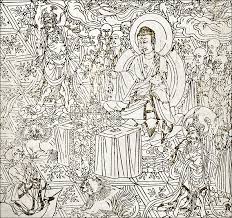 Master and disciple had set a skilful “throwing and catching” role playing game, to lead a new category of disciples, engaged ones, those who were ready to descend their mountains to save and protect beings instead of silently sit under trees, as did the recluses whose only purpose was to find a way to self-liberation. Therefore, throughout this entire Sutra, the Buddha had repeated many times and frequently incited his disciples to “expound it to others”, “widely expound it to others”, even if it is as much as one stanza or merely one single word! Throughout the whole Diamond Sutra, we can see that the Buddha earnestly wanted to widely expand his true teaching, so that the Dharma wheel could turn quickly in order to save beings from their blazing houses! How can we afford to sit idle and to take all our time when our houses are on fire? We must act. Must be quick. Must put the fire out. Must save the people even if we get burnt in the process, which means that if we were misunderstood, scoffed at or insulted. In that case we must understand that this impediment is due to our unwholesome karma committed in past lives, and they must inexorably be followed by retribution. Let’s keep going on patiently, diligently. Let’s not lose heart or waver. But dangers still are lurking there, as we still can easily build new barriers that would thwart all our efforts to develop because of our propensity to grasp and our arrogance, self-importance.
Therefore, although having thoroughly delivered his teaching, the Buddha did not mind repeating again and again that the Dharma preached by Him is unconceivable, unattainable, not real nor unreal. It is the raft that takes us across the river, the forefinger that points to the moon! But in the enthusiastic, ebullient atmosphere of this ceremony of handing down the precious sword, new problems still might arise.
Maybe Subhuti, perceiving the not yet peaceful, not yet restful minds of those present in this audience, had no choice but to ask this question anew. He was not forgetful, nor was he in his dotage!
But actually, in the first haft of the Sutra, the Buddha had delivered only… half of His teaching. There still was the other half. In the first half of this Sutra, He emphasized that there was a kind of “Dharma” to be practiced in order to have a pure, peaceful mind. “As to Dharma, when practicing…” means that one must practice according to this very teaching. One can keep practicing the virtue of giving, of discipline, of forbearance and so on, provided that it is done in a new way. “To give is not giving”. One must go beyond, transcend, not get caught up, not get tangled in form and must not “dwell anywhere”. If one still clings to form, one is still stuck in delusion! One must see that form is not form so as to apprehend its nature, its truth, its “Thusness”. In other words, the form still is something very physical, something that can be seen, heard, tasted, smelled and touched. In general, those things are not difficult to discard or to get rid of. There is nothing else to do but to hide in mountain caves or in deep forests. Even in this flat world, we can still switch the TV off or push a button to cut ourselves from them. Feigning blindness, deafness and dumbness is not difficult. It’s so easy to do, then why still are we so tormented, harrowed and at sixes and sevens? And when we have time to “look back at ourselves”, as Trịnh Công Sơn said, “our life had gone by…”(nhìn lại mình đời đã xanh rêu).
Is it so easy to “discard the form”? Is there something more difficult to discard? There is. The first love is forever beautiful. The first loved one is always wonderful (provided that we don’t have to see him/her again). A word from our enemy is always infuriating. Waiting 10 years is not too long to take our revenge. But “not yet avenged, our hair had turned white” (Thù trả chưa xong đầu đã bạc) (Đặng Dung)
What makes us infuriated, what makes us so mad? What makes us see that things are better or worse? It is no longer the form, but our perception, our mind, our thoughts. They are not to be seen, heard of smelled! They lurk somewhere, in an invisible “store”, ready to burst into flames inside us with magical powers. “How was the rain in the old days? Now why does it look so sad…” (Ngày xưa mưa rơi thì sao ? Bây chừ mưa rơi lại buồn…) (Tôn Nữ Thụy Khương – Minh Kỳ). The sadness does not come from the rain but from our mind. How can we escape, subdue, pacify that tiresome mind? What a good question, worth asking many time! In short the first half of the Diamond Sutra taught how to “discard form” and the second half taught how to discard the thoughts, or how to tame the mind. The easy part was taught first, and the difficult one was to be taught later! Subhuti was right to ask it twice!
It’s clear that the answer to the same question is different! When one just “lightly” generated the Bodhicitta, one must apply such or such method. Now that we know how to generate “that” mind, it is easier for us to think that we have a “dharma” to teach and to spread out, we are more easily got caught up and entangled than before, more easily inclined to carry on the raft after crossing the river and expect that people look at our own finger…
What did the Buddha teach? That there is no dharma to attain! What was called “Anuttara Samyak Sambodhi (Highest Perfect Wisdom) is already there, everybody has it, but it is just hidden, obscured! How can we “attain” something that we already have? But we cannot say that it doesn’t exist. It is and it is not. It is not, but it is. Not real and not unreal. How interesting to behold what is concealed inside every “dharma” (phenomenon), to go beyond every form to perceive the “real form” (the insight into the Reality). Then one perceives that “every Dharma is Buddhadharma”. The term “Dharma” is no longer restricted as a method, a mean, but is the entire functioning of our mind and the content of our mind. In that way the “Empty I” is the same as the “Empty Other”!
“Subhuti, if a Bodhisattva comprehends that all Dharma are devoid of a self, the Tathagata calls him a true Bothisattva”. A bodhisattva must comprehend “Emty I” as well as “Empty other” to deserve to be called a bodhisattva.
The “empty I” and “empty other” are like the two wings that allow a bird to fly. Like the “Dragon Slaying Sabre” (Long Đồ đao) needed the “Heaven Sword” (Ỷ thiên kiếm) and the “Heaven Sword” needed the “Dragon Slaying Sabre” [to be whole]! When he discovered the secret concealed in the Dragon Slaying Sabre, and once he conquered back his country’s from foreign invaders, Trương Vô Kỵ (character in Kim Dung’s martial novels) went back home to… draw on Triệu Minh’s (his wife) eyebrows ! Once the king Trần Nhân Tôn defeated the Yuan and Mongol, he dropped out of everything and alone on his horse, went back to the Mount Yên Tử!
What a wonderful example of being “empty minded in front of any phenomenon”!
8. Neither one nor different
The sentence “All dharmas are Buddhadharmas” does not mean that all dharmas – all phenomena – are… the Buddha’s creation. It only means that no dharma has an inherent, intrinsic self. They have no self-existence because they are impermanent, interdependent…They have no inherent existence. They come to life because of conditions that, like chemical reactions come to life because of catalysis, temperature, a certain pressure… of the mind. They come together then break up, appear then disappear. Like evening clouds, morning rain, lightning flash or dew… Mind is impermanent, the dharmas have no intrinsic self. The Buddha was an enlightened ordinary being who had well understood these obvious things and was liberated from suffering. And what about us? We also see and know those things, but why are we still busy looking for… what?
Because we immediately forgot what we saw and knew, unwilling to “correct ourselves” or to “cultivate” and to shape our own mind, that we are always in for difficulties, and must face suffering, hardships. Serves us right! Those who consent to change and cultivate themselves, who are able to see things as they are will be joyful and happy because they have “dropped their burden”! A society in which everybody is joyful and happy can prove to be a paradise, the Nirvana? Why not? One can call it a Buddha field. Paradise or nirvana can be right here, right now if we know how to transform our human land into a Buddha field!
May be the every attendee of the assembly – of good men and women – who was able to learn the lesson during this ceremony of handing down the precious sword on that day had immediately imagined the sight of
Sweetly chirping, the birds made offerings of fruits in the Mai forest
Leisurely swimming, the fishes listened to the Sutra in the Yen spring
(Thỏ thẻ rừng mai chim cúng trái
lững lờ khe Yến cá nghe kinh).
(Chu Mạnh Trinh)
and they would be eager to do something, to organizing or arranging something to create a peaceful and clean world for all. Some might be thinking of blowing the trumpet in order to attract the “sentient beings” and take this opportunity to… “fully explain it to” them!
But the Buddha knew us of old, so he severely continued: “Adornment of Buddha fields is no adornment, therefore it is called adornment”.
While adorning, if one makes it too pompously and extravagantly, then one is … caught up, stuck in… and is not qualified to be called a Bodhisattva. It is just like an unskilful physician who would display an array of professional tools and pour out a stream of Latin medical terms to impress or intimidate the patients. A skilful physician doesn’t need to do so. He does not have to exhibit anything or intimidate anyone. There’s no need of adornment and still be adorned. The adornment must come from the inside! The Bodhisattva who carefully and thoroughly practices the six paramitas and all the virtues does not need adornment but still is adorned! Despite of this, one would be wrong to say that adornment is unnecessary and thus look down on adornment. Because [in this case], there is nothing else to do than to return to the mountain or sit under a tree, and keep silent when being asked questions!
I like to roam over different places to visit temples or monasteries, to wander about while watching, breathing and learning. Some places used to be quiet, genuine and restful, which make one feel light-hearted and airy, but today, market driven, they become so showy and gaudy that they make one feel nonplussed and bewildered! However, with hindsight, it dawns upon me that it is my concerns and does not involve the flag nor the wind!
Building temples, pagodas, statues and casting bells are necessary, as much as beating the wooden fish and chanting the Buddha’s name. To recite the Buddha’s name accompanied by the wooden fish and attain the singleness of mind is, isn’t it, an experience of concentration and wisdom? To pray until one melt into and make one with the stone statue is, isn’t it, an experience of concentration? To prostrate correctly in front of the Buddha, combining with one’s clearly aware breathings not only does not cause back-ache, arthritis but even helps blood circulation and improves one’s immune system, as well as the suppleness of one’s body!
The sight of
Sweetly chirping, the birds made offerings of fruits in the Mai forest
Leisurely swimming, the fishes listened to the Sutra in the Yen spring
Gently a tocsin was sounded close to the traveller’s ears
Giving him a jolt in the middle of a dream…
(Thỏ thẻ rừng mai chim cúng trái
lững lờ khe Yến cá nghe kinh
Vẳng bên tai một tiếng chày kình
Khách tang hải giật mình trong giấc mộng (Chu Mạnh Trinh)
It is quite necessary to be given a jolt. One need to be startled out of bed to wake up, then be awaken and then… attain enlightenment! One cannot afford to discount formalities!
Without the Cold Mountain Temple (Hàn San Tự), how could the traveller, in the depth of the night, hear the sound of the bell that had rung for thousands of years and touched his heart now?
Moon sets, crows cry and frost fills all the sky
By maples and boat lights, I sleepless lie
Outside the Suzhou Han Shan Temple is in sight
Its ringing bells reach my boat at midnight
(Nguyệt lạc ô đề sương mãn thiên
Giang phong ngư hỏa đối sầu miên
Cô Tô thành ngoại Hàn San tự
Dạ bán chung thanh đáo khách thuyền)
(Trương Kế)
But why the traveller should be awaken because of the bell ringing at the Han San Temple? Was it because of the wane moon, the crows’ cawing, the night mist, the light on the fishing boat, or the maples along the shoves…all that had prepared his mind, “adorned” it to hear the midnight ringing bell? The bell ringer had no after-thoughts, neither had the bell ringing…
While studying the Diamond Sutra, I was always amazed. Whenever I was enthusiastic, it seemed that a bucket of cold water was thrown at me; whenever I was lost in my dreams, it seemed that my side-whiskers were tugged; when everything seemed to go smoothly, something would suddenly jolt me; if I was about to be critical, I would slap my thighs “but that is the way it is!” and if I was pleased with myself, my head was smacked as a rebuke “you are way off the mark, my boy!”
Studying and pondering over the Diamond Sutra, one can find out that it’s clearly divided up into two distinct sections, but closely mingled and interlaced together. They are two but are one, are one but are two. They are not one neither are different. In the first section we learn to “give up form-appearance” (do not dwell anywhere to give rise to a mind). In the second section we learn to “give up thoughts” (go on giving rise to a mind as long as you don’t rest it anywhere). We learn not to be stuck in forms, sounds, smells etc… A Bodhisattva who is doggedly seeking the path through forms and sounds etc… is “practicing in the wrong way”. His mind must be clear so that his teaching can be clear. Flags and drums are only excuses, pretexts that should not trap him. One should practice diligently to obtain a mighty inner energy, and not hurry to show off tactics or techniques. Beginners in martial arts often enjoy moves and techniques. When your energy is sufficiently powerful, to flick one’s finger, lift one’s leg, pluck a string of a music instrument or play a tune on a flute can turn out to be a supreme move.
9. The other eye…
Right in the middle of the lively debate about “adornment is not adornment, therefore it’s truly adornment”, the Buddha abruptly switched to another subject altogether. “Subhuti! What do you think? Does the Tathagata have the flesh eye?” “Yes, World Honored One! The Tathagata does have the flesh eye”. Subhuti hurriedly answered. If we were to answer the Buddha’s question, chance is that we would have stammered and dared not utter a single word. Undoubtedly, we think that the Buddha must have the Buddha eye, and only ordinary beings like us have the flesh eye. Who would expect that the Buddha, like any ordinary being, also has the flesh eye as stated in the Diamond Sutra? Isn’t it a good new? Our confidence suddenly sky-rocked! It is not surprising that the Bodhisattva Never Disparaging, upon seeing anybody would respectfully hail them “I have a profound reverence for you, a future Buddha!” No wonder Subhuti had said “Yes, World Honoured One” five times in all! As it turns out, the Buddha had all the 5 eyes: flesh eye, heavenly eye, wisdom eye, dharma eye and Buddha eye… So there are no less than 5 kinds of eye, isn’t that a bit too many of them?
Sure, the eyes are used to “look at” and “to see”! And so many kinds of eye are meant for seeing in many… ways –in other words, to see under different standpoints, or different angles- Otherwise, if we obstinately cling to our own point of view, stubbornly consider that we are right and others are wrong, we will end up quarrelling and even coming to blows! It’s how we “see” that matters. The way we see will determine out thinking, our speech and our acts. A wrong view will lead us to erroneous thoughts and improper actions. So the Avalokiteshvara Bodhisattva needs a thousand eyes and a thousand arms with one eye on each hand!
To see and to know are closely related but they are not the same. Things look like that, but are not that; they don’t seem to be that, but they are. To see can lead to knowledge, but the knowledge is not the result of the seeing. We see with our eye, but we know through our… brain! Hence conflicts, clash of viewpoints and “delusion”! Deep knowledge enhances open minded behaviours, shallow knowledge leads to narrow mind; those who have distorted and short views are like a frog at the bottom of a well and would imagine that the sky is no larger than its lid!
Among the Eightfold Path, the right vision ranks first. A vision, if not right, would easily lead to deviant views. There is no right thinking without a right vision. Otherwise one would indulge in sophistry and idly talk that won’t get one anywhere.
At times, we see the same thing but “know” entirely different thing. Like the story of a married couple going to the circus. A young and fetching scarcely clothed acrobat was suspended from a swing on the stage. The wife suddenly cried: “She has nothing below!” The husband nodded in agreement, but at closer look he said: “No, she has a flesh colour tight below!” “I meant that there is no security net under the swing, but you, pray, what did you mean?”
As it turned out, to love is indeed to look at the same direction… but what each lover sees is not the same! The wife was compassionate, and the husband was full of… loving-kindness!
The flesh eye by itself can be worrisome. The eye ball slightly bigger than normal and here we are with short-sightedness, confounding everything! An irregular curve in the cornea and we are landed with stigmatism and see everything distorted, then colour-blindness, night-blindness etc… Not to forget glaucoma, cataract, retinal detachment, macular degeneration, floaters in the eye… that we blame the space instead of our own aged vision! When we lose a knife, it is precisely the flesh eye that makes us perceive everybody as a thief of knife. The flesh eye is only a structure of the “Four elements” that allows us to see but does not allow us to know. The knowing is located behind, up there in the cortex, in the occipital lobe!
The flesh eye only perceives light, shape and colour… then passes the information on to the neocortex to be analysed, organized and compared… Our world is the reflection of our mind. Then as it sees fit, our mind would embroider, deduce, assess at will, and send us to jump down someone’s throat, to scrap, to brawl and get injured, only because of a divergence of opinions! The flesh eyes are not at fault. When the sense organs meet with their sense objects and produce a form (or an appearance), this form is not at fault either. It is none other than our meddlesome mind, when stuck in this form and brings about thoughts and perceptions, that troubles arise! Only the arahants are said to be free of any trouble arising because they are liberated!
The matter is how to transform and to train that mind to make it sees and knows rightly. [Is it easy to transform] such a deluded, distorted, stressed, weary, a busybody and trouble maker of a mind, into a non-rebirth, peaceful, without mental formation mind… so that we can be carefree and happy ? Not easy, but feasible. For that, we must make joyful efforts, practice meditation… to attain wisdom. Thus practicing, with time we can acquire… new eyes!
Heavenly eyes are all kinds of today’s scanners, echography, MRI etc… They are also those electronic microscopy tele-objectives that can enlarge up to a million times, and see millions of light years distances! At the Buddha’s time, there was no electronic microscopies, no tele-objectives, no MRI, no echography… but the Buddha had been able to see countless of living beings in a glass of water, or countless of universes to conclude that we are not alone in this earth! Obviously, the Buddha had… heavenly eyes! The scientists don’t go further than the heavenly eyes. Because they are busy searching, discovering in the outside world and forget to look into the inner world. Except scientists of Einstein’s dimension! Lately physicists and biologists, with their advanced scientific and technological skills had seemed to be able to “see” many strange things that considerably startle them.
The wisdom eye is the third, unequalled one, the eye that clearly see the True Emptiness is also the Inherent Transcendental Essence, the impermanence and the no-self. The Wisdom Eye might be sufficient. Sufficient to [make us] stop, to [make us] look back. To go to the “other shore”. To smile alone. Leisurely. Amused. Carefree.
But it seems that things were not yet concluded here. If there was nothing more, may be the Buddha only needed to hang about his Bodhi tree, but why should He, throughout his life, face fool weathers to beg for alms and pass down his doctrine? His disciple might also have spent their lives peacefully, and there wouldn’t be any ceremony of “handing-down the precious sword” in order to lead a bunch of good men and women to engage their life into the Bodhisattva-hood.
So the Dharma eye is necessary. The Dharma eye makes one idealistic, have beautiful perspectives and become somewhat romantic! To do so the Bodhisattvas must make sacrifices, take vows and above all… be appropriately inoculated before descending the mountain. Failing to do so, they would easily be infected by the pollution and get sick! The Diamond Sutra repeatedly, severely reminded them that without this or that condition, they were not yet qualified as a Bodhisattva. With this Dharma eye, they are now ready to face the challenges of the Samsaric world! In Siddharta, one of Hermann Hesse’s novels, the main character embodied this example. He was a monk who, meddling with worldly life, met a beautiful woman and went into business. At first everything went smoothly but it ended in a fiasco. In despair, he wanted to take his life at the river bank, but suddenly, the river spoke to him and he was awaken! This time he was really awaken. Last time, dressed in monk’s robe he thought he was but was not. Later, he became an old man, day after day rowing a boat to and fro to ferry people across the river. Once obtained the Dharma eye, one can acclimate oneself to every situation, to every trial and tribulation without wavering.
“Subhuti, what do you think? Does the Tathagata have the Buddha eye?” If the Buddha does not have it, who else does? But what is that “Buddha eye”? It is the Buddha’s insight and wisdom, what He saw and what He knew. A Zen master told: “30 years earlier, before treading on the Path, I perceived that mountains were mountains and rivers were rivers. Then thanks to good Dharma friends, I entered the path and perceived that mountains were no longer mountains and rivers were no longer rivers. Now that I have realized the true calmness and happiness, once again I perceive that mountains are mountains, and rivers are rivers”.
The Buddha did not need to waste so much time. With His Buddha eye and “Buddha’s insight and wisdom”, mountains have always been mountains and rivers have always been rivers. But they are different mountains and rivers. They are the rivers of “form is emptiness” and the mountains of “emptiness is form”. The Buddha was not caught, not stuck.
Bùi Giáng, a poet who was completely immersed in the Diamond Sutra and used to put the question “Why is that?” in his poems, once wrote: “of both eyes that are left to me, one is shedding tears for human beings”(Còn hai con mắt khóc người một con…)
The musician Trịnh Công Sơn continued “of both eyes, one is crying for human beings, and the other one?” (còn hai con mắt một con khóc người! Con mắt còn lại?)
Yes, what about the other eye?
The other eye sees… two images of one person
“One sees a loving you, the other sees you as a wild animal…”
“Whose is the other eye?
The other eye looks at me… and sighs!
(Con mắt còn lại… nhìn một thành hai
nhìn em yêu thương nhìn em thú dữ…
Con mắt còn lại là con mắt ai ?
Con mắt còn lại nhìn tôi thở dài!)
(Trịnh Công Sơn)
“Right, the other eye is really troublesome! It is affected by diplopia, seeing double, perceiving two images instead of one. But when affected by diplopia one sees exactly the identical images instead of a love one in one hand and a wild animal in the other hand. It stares at our “ups and downs” with a hostile and resentful glare. It seems to belong to some else – “Whose is the other eye?” -, it watches us, evaluates us and then… sighs nastily. It sighs because it pities us, thinking that we have got what we deserve! Why so much self-torture? It is the “consciousness eye”, the consciousness that makes discrimination, comparison, judgement! When “consciousness” becomes “wisdom”, things also become different! This wisdom mentioned here is the Prajna. Then:
The other eye
Sees that life is emptiness
Sees that you have no-self,
As the shadow under the sun!
(Con mắt còn lại
nhìn đời là không
nhìn em hư vô
nhìn em bóng nắng)
It sees life is emptiness and not “non-existent”. To see the empty nature of things also means to see their true mode of existence, the existence that is emptiness. Emptiness is form. Emptiness does not differ from form. [Everything] is interdependent. Impermanent.
In short, of both eyes, the one that is “shedding tears for human beings” is the compassionate eye! And the eye that “Sees that life is emptiness” is the Wisdom eye. Compassion without wisdom makes one shed endless tears, impossible to be comforted! The Wisdom eye is essential to our liberation.
Our own and others’ liberation, evidently!
10. “So in this way…”
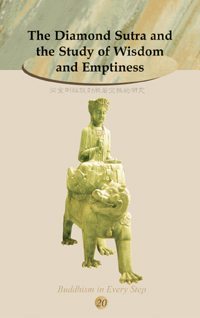 As I said earlier, while studying and pondering over the Diamond Sutra, an ordinary being as myself rocked endlessly from being baffled by one thing to being puzzled by another, but I was never as baffled and puzzled as when I reached the final part of the Sutra! Actually as I see it, each part of the Sutra can be considered as the final part, each sentence as the conclusive one! Again and again, when I thought that it was finished, done, closed, then unexpectedly a new, more profound, more expansive and extraordinary horizon opened up and unfolded before me.
In the final part, while the Sutra was discussing elaborated, profound topics from particles of dust to world systems, then “unity of appearances” and so forth, suddenly the same question was repeated: “How to expound this Sutra to others?” which was the main subject throughout the whole ceremony of “handing down the precious sword” to the good men and women which would become the future Bodhisattvas! The answer was very firm: “By not grasping at appearances and being in unmoving Thusness”. This means: it is very easy, don’t cling to the phenomena or attach to appearance and you will see the unmoving Thusness since time immemorial! But how to “not grasping at appearance”, and remain in “unmoving Thusness” when we are surrounded by intertwining and meshing [relationships]? While we were still busy mulling over and sweating out, we heard “why so?” and the conclusion: “Contemplate them thus”.
“Contemplate them thus?” “Them”? What must one contemplate? How to contemplate? What is the use of contemplating? The answer is to go on “contemplating” (observing, watching) what is happening right under our very eyes, things that are known to everybody, that were always discussed again and again! So we are totally on the wrong track! We had thought of grand things, remote, unfathomable things. But surprisingly, it was about “contemplating” very ordinary things around us and consider them as dreams, a rainbow, morning dew, lightning flash… Nothing new, nothing mysterious there! So simple? As simple as that and it can absolutely solve the key problem, which is how to establish one mind, how subdue it, and from there to “receive and retain and clearly expound (this Sutra) to others”? Quite so, the Diamond Sutra agrees. Nothing else is necessary! All you have to do is to act according to your “contemplating them thus” and you are done! [Hearing that], how can one not being puzzled or baffled!
I recollect that at the beginning, when I first approached the Diamond Sutra, I also thought that it must be about something awfully tremendous and fabulous. I didn’t expect that it was only about the Buddha being hungry, took his bowl to collect alms, went back home, sat down on the seat arranged for him, ate, put away his bowl and cloak, then crossed his legs and… breathed! Only that! Then at this final part, I also expected something scholarly erudite and highbrowed, but there is nothing more than observing very ordinary daily things that are known to everybody, that all can see and know. What for? To experience impermanence, illusion, chimera…? But it is common knowledge!
We all cried loudly at birth
If life was happiness, why didn’t we laugh then?
(Thoạt sinh ra thì đà khóc chóe
Trần có vui sao chẳng cười khì)
Or life is “as floating clouds, blowing wind, dreams…”
“như mây nổi, như gió thổi, như chiêm bao
(Nguyễn Công Trứ)
and then:
“How provoking is the dream of Nam Kha,
when my eyes popped open, I realized that I am as destitute as ever!”
(Giấc Nam Kha khéo bất bình,
Bừng con mắt dậy thấy mình tay không)
(Nguyễn Gia Thiều)
But how is it that the 6th Zen Patriarch Huệ Năng only eavesdropped one sentence in the Diamond Sutra and attained enlightenment? Why someone like Nguyễn Du who pondered the Diamond Sutra thousands of times and in the end discovered that only “wordless sutras are genuine teachings”!
Wordless Sutras? Why, is it possible that the Diamond Sutra that we are perusing, studying is only… the shell of a Sutra that was only borrowed to be expressed in human language, where words were being assembled to become a raft to cross the river? Why not? Otherwise, why in the Diamond Sutra, as soon as a word was uttered it was immediately erased, for fear that people would take it as The Truth and cling to it? It was not without reason that Huệ Năng said he did not know a single word, he only knew the meaning of it. To know the meaning is to know beyond words and not attached to words. But Huệ Năng also said that one must not mistake even one single word or miss even one single sentence when study Buddhism. How very interesting!
It must be very difficult to read between the lines of a Sutra, to read a “wordless Sutra”! Each person would read it differently. That is why it is said that there are 84 000 Dharma doors to fit each being’s aptitude. Therefore clearly it is not appropriate to divide the Sutra into sections and attach a sub-title to each of them. People would feel they must grasp the idea [of the sub-title] to work with and cling to it in order to study then to “expound it to others…” Where is the Diamond Sutra’s unconventional, unconstrained spirit then?
I cogitated and practiced the Diamond Sutra in my own fashion. Sometimes I assembled pieces together as I would for a puzzle, and at other times I would turn them over and over as for a rubik’s cube… When facing a problem in my daily life, I use to wonder how the Diamond Sutra would say in this situation. Oh yes, here it said that we must discard the forms or the appearance. [Grasping] forms would lead us to the wrong way. And there, it said that to discard the forms is not enough, we must also discard the thoughts. Not dwelling anywhere to give rise to a mind. At this place things are said to be this but actually they are not! And at other places, things appear not to be the way but in fact they are! “A is not A, therefore it is called A”! Ah yes, we must not be attached to, grasp or doggedly hold on to things. If we doggedly hold on to and grasp and attach to things, we’ll only drive ourselves headlong to suffering. We must not “dwell on any form” to, with a bit of luck, perceive the Truth. But do not think that forms don’t exist! Don’t be so innocent as to “abolish” form. Mountains are still a mountains and rivers, rivers. The elephant still is the elephant, will all of its head, tail and trunk. But it’s also a rubik’s cube, a puzzle. It is impermanent. Interdependent. It has no inherent existence. Don’t let us fight over our own way of feeling an elephant. Let’s behold with all of the 5 eyes in order to look. Look in details at each dust particle then look at the immense delusive realm of the billion-galactic-world universe, to see the “unity of appearances”. Let’s look with the wisdom eye of every ksana (sát na: shortest moments) and then with that of the eternity or of thousands of years, we’ll see so many funny things that should make us smile with amusement instead of suffering and giving rise to negative emotions ! And then one day one realizes that “Suddenly I feel compassion”(lòng chợt từ bi bất ngờ) (Trịnh Công Sơn). Yes, we must feel compassion toward ourselves and toward others, and toward all those ego, personality, being, life-spans… too!
If we enlarge a picture of someone to the utmost size, even if this person was very close to us, we still cannot recognize him because we can only see bright points and blurred colours. Those scattered bright, blurred colours are no one’s characteristics. When they gather together under certain conditions, we then recognize the picture of someone whom we know or not…
The modern physics also perceive that the nature of fundamental particles is the lacking of consistency, they only interact and combine together to create matter and the spiral structure of time and space. Matter and space-time are one. If matter ceases to exist, space and time would also disappear. The nano-world is an ever vibrating universe…
The Diamond Sutra starts by a so very commonplace story: eating, sleeping, walking, standing up, lying down, sitting, breathing… and also end by so very much everyday life’s things such as a dream, a fault of vision, a lighting flash or a cloud… So it’s those things just under our eyes, those so commonplace things that precisely make up life and living. It’s those “present realities” that make up a human’s life. The Buddha declined to speak about convoluted metaphysics or supernatural powers. Let’s attend to that man’s arrow injuries. Let’s pull out the arrow, clean the lesion, remove the venom, dress the wound… first! Happiness is not far away, it does not fall down from the sky nor is it meted out by someone else. Happiness is inside us and around us. Happiness or suffering, paradise or hell are things that we self-create for ourselves, so they also must be managed by ourselves. Those “inexhaustible defilements” also are the “immeasurable Bodhi”!
What makes the difference (as used in modern language)? Why in the same situation, there are some who are relax and carefree, and other who suffer agonising torments?
The answer is, to understand the truth of Paramitas, one cannot stop at words but has to meditate, to work on it, to “practice deeply the Paramita”. The purpose of the Diamond Sutra is to teach us how to practice that way. To cure diseases one has to take medications and not restrict oneself to reading the prescriptions at the risk of …going nuts!
This ceremony of “handing down the precious sword” is precisely to prepare the good men and women – the future Bodhisattvas – to actively engage themselves in the mundane world. This also means that they still have to eat, do the laundry, brush their teeth and change their clothes…, they still have to see what others see, hear what others hear and tell what others tell. But they also have to practice the 6 paramitas and all other virtues, their bearing must be dignified, their speech must not be confused, their view must not be blurred. In short, they have to live a true “paramita” life to be a true Bodhisattva! That is the reason why they must practice joyous effort and forbearance! Throughout the Diamond Sutra, the Buddha had insisted very severely on those mandatory conditions. What teaching is better than the lessons learned from reality of life…. so that students can attain happiness, above all can know how to share their happy life with everybody. To share not as if one would share a cookie, but to teach how to make that cookie!
The Diamond Sutra demands practicing. We must personally “deeply practice the paramita” first, and then we can expound, can teach at will! Our mind must be clear to give a clear teaching.
Samatha and Vipassyana. That was the path that the Buddha had trodden. “Just come. Taste it. See it”. No need to engage into dogma or idle talks. Like the experimental science, it is precise and universal. One must try it out for oneself.
One person who saw dream, rainbow, morning dew, lightning flash… as dream, rainbow, morning dew, lightning flash, would only perceive the perishing, illusory side full of delusion and suffering [of the world]. But the other one who was conferred the “precious sword” would be able to look with the 5 kinds of eye, and would see that behind decay and illusion, there is interdependence, emptiness, no-self, something essential, the Suchness, Thusness… The rainbow is what it is, it isn’t more brilliant because we’re in love, and it fades out independently of our being out of love. The dream, rainbow, morning dew, lightning flash do have something wonderful, as well as the cycle of formation, continuation, destruction and extinction. Then one can, unflappably, stroll into the bustle of the market place of the world, immune to any affliction. To live in the @ time and not get into delusion, isn’t that nice?
You should “thus” subdue your mind. This is Samatha; you should “thus” look deeply into the nature of every phenomenon. This is Vipassyana. Those are the only way to “By not grasping at appearances and being in unmoving Thusness”…
Nguyễn Du read the Diamond Sutra thousands of times, and it was worth it. He not only read but had really “deeply practiced”!
Emptiness is omnipresent: where are forms?
My mind permanently in concentration, I’m closed to (dhyana) absorption!
Mãn cảnh giai không hà hữu tướng
Thử tâm thường định bất ly thiền)
Suchness – the Truth – never changes. Only our mind does. “The peach-blossoms are still smiling at th’ Spring breeze!” (Hoa đào năm ngoái còn cười gió đông)
No matter how much Thôi Hộ, the poet, suffered because the last year’s “blushed face” was gone, “but where?” Where? Nowhere! Because it also came from nowhere.
To discard the form is different than “not rely upon forms”. To discard means also to stay away from. One goes up to the mountain or down to the river in order to stay away from mankind and seek comfort in nature… “Not rely upon” means that one is not stuck once engaged to, participate and bear hardships in this world here below. To discard is something that manifests on the outside, but to rely upon occurs on the inside, in the mind. That’s why “not relying upon” is more difficult. It also is Trần Nhân Tông’s “empty-mind” of and Huệ Năng’s “no-thought”. Grasping (tanha) is the result of Craving (upadana). And Grasping will generate the Karmic Force (bhava). Craving, grasping and Karmic Force… bring troubles into life! That is the reason why “not relying upon forms” is more difficult that “discarding forms”. The practitioner who can “discard all the forms” is called Buddha, but he who “doesn’t rely upon forms” is named “unmoving Thusness,” “Tathagata”, “Ultimate Truth”!
But in spite of the principle of “emptiness”, of “no-self”, everything still has its form. “Worldly dharmas continuously abide” (Lotus Sutra). ”
“Whatever is the situation, my heart is steadfast; although steadfast, it still can adapt itself to every situation” (Tùy duyên mà bất biến, bất biến mà tùy duyên). Isn’t that interesting?
Let the mind waver and bring troubles about, let our consciousness and perception mess up everything, and we only have ourselves to blame for! We are responsible for our “immeasurable inflictions”! Simply for the reason that we make a mess of everything, and cannot “be in unmoving Thusness”! ”
I was stupid all my life, I made myself miserable… Wake up in the night, I clutched my long hairs that dimly looked like white reeds ” (Đời tôi ngốc dại, tự làm khô héo tôi đây, Chiều hôm thức dậy, ngồi ôm tóc dài, chập chờn lau trắng trong tay…)(Trịnh Công Sơn).
May be the Anuttara Samyak Sambodhi (Unsurpassed, Proper and Equal, Right Enlightenment) is the ultimate realization, not real nor unreal, while the Bodhi heart (Bodhicitta) is a real mind, which sprang from seeds that had been planted and nurtured. Thần Tú was right to enjoin us to diligently water and look after our “Bodhi tree”, protecting it from being parched and wilted, as we must diligently mind our own mirror and not let dust and cobwebs soil it. It isn’t easy to make joyful effort or to have a patient endurance! To benefit oneself and others. If one isn’t compassionate toward oneself, how can one be toward others? [Avalokiteshvara Bodhisattva] must be “The Buddha of Carefree Observance” first and then the “Hearer of the Cries of the World” later. Therefore at the end, the Diamond Sutra only mentioned the “Bodhicitta” of the future Bodhisattvas and said nothing about that not real nor unreal Unuttara… That is the very realistic spirit of the Diamond Sutra.
If we observe Sakya Muni Buddha’s meditating path, we can see that He was beset by not a few difficulties. Despite that He mastered the 8 first Dhyana stages, He was still not awaken and still under the disturbance of the “perception”. He had to find a path of His own after a long time of hard ascetic practices. One can say that it was a break-through, from quantity to quality. It was the ninth Dhyana stage, the “extinction of Sensation and Perception”. Then Perception was no more to disturb, Sensation was also extinguished and can no longer “trigger off”. “Being in unmoving Thusness” was now possible. It was also possible to realize that “Yet of the immeasurable, boundless numbers of living beings thus taken across to extinction, there is actually no living being taken across to extinction”.
There was no more “coming to being”, and so no more “extinction”. Like someone who know how to remain fit, going to the works-out and so on, wouldn’t get sick and has no reason to take medicine. Disease and sickness can dwindle away, but “immeasurable inflictions” from greed – hatred and ignorance – are still there, so one must have a new vision, a new insight in order to go beyond, gate, gate, paragate… [one must practice] paramita to ultimately resolve them. This path is essential for future Bodhisattvas – the good men and women –, it’s a compulsory condition. The Samatha helps to liberate and the Vipashyana helps to go beyond. Only by expertly practicing profound paramita, then he can “discard at appearances and be in unmoving Thusness” then “expound it to others”.
When one recognize the principles of Impermanence, no-self and emptiness… it turns out that everything is precious, wonderful! No question to be negative or to let go here. Don’t speak of “extinction”. The Diamond Sutra was adamant. To uphold “eternalism” is wrong, but to uphold “nihilist” is worse. Seeing that things exist is wrong but to see that they don’t have any existence is worse. The Bodhisattva “do not destroy compounded things nor resting in the uncompounded” (bất diệt hữu vi bất trụ vô vi) (Vimalakirtinirdesasutra). Without the compounded, the uncompounded can’t be seen! Mountains are always mountains and rivers are always rivers, the only difference lays in a long way of unrelenting staunch cultivation and practice to recognize that “form is emptiness and emptiness is form”, “True Emptiness is also Inherent Transcendental Essence”… The transformation can only come from inside. Samatha and Vipashyana. The path is traced. The preparation is completed. It’s not without reason that make joyous effort and patient forbearance are unavoidable paramitas on the progress into one’s inner journey.
When we have no more grasping or clinging, everything becomes light, serene and unencumbered.
The “precious sword” has been handed down since!
“And in this way I entered life
I loved this life with all my heart”
Và như thế tôi đến trong cuộc đời
Đã yêu cuộc đời này bằng trái tim của tôi…(Trịnh Công Sơn)
Author: Đỗ Hồng Ngọc
(Saigon 2008 May)
Translator: Giao Trinh Diệu Hạnh
(Paris, 2015 April)
………………………………………………………………………………….
NOTE
Handing down the Precious Sword
(Gươm Báu Trao Tay)
In 2003, I got my book “Thinking from the heart” (Nghĩ từ trái tim) published. Unexpectedly, it was warmly welcomed by many of my friends at home and abroad. Some of them even expressed the wish to see it translated into English so that their children – the second generation who don’t speak Vietnamese – could read and understand the Heart Sutra (Prajñāpāramitāhṛdaya). In 2008, I published “Gươm báu trao tay” (Handing down the Precious Sword) where I’ve put down my reflections and insights after a long time studying, mulling over and practicing the Diamond Sutra. I was like that physician of olden times who climbed the mountain to collect medicinal herbs for many years, first to cure himself and then to share them with friends who suffer the same illness… The almost totality of these writings were published in the Van Hoa Phat Giao (Buddhist Culture) and later on, in a couple of Buddhist websites too. A few years ago, The Xa Loi Temple’s Dharma study group invited me to address the topic of “How to apply the Diamond Sutra to our life” and it was also quite appreciated. Once again, my friends suggested that “Gươm báu trao tay” should be translated into English to offer their friends and family living abroad the opportunity to read it.
Only recently, favourable conditions conducive to this translation turned up. One of my readers living in Paris, Giao Trinh Diệu Hạnh was willing to give it a try. I was so glad! Giao Trinh Diệu Hạnh is a professional translator and a devoted Buddhist. She often translated for the Vietnamese Venerables and Tibetan Rinpoches when they give teachings or Dharma talks in France. She also, in collaboration with Nguyen Minh Tien, translated two of Mingyur Rinpoche’s books into Vietnamese: The Joy of Living and Joyful Wisdom. I’ve never met Giao Trinh Diệu Hạnh, we only communicated by emails during the translation of my book, but she proved to be very serious and meticulous in her work.
Do Hong Ngoc, MD
(2015)
……………………………
At first, I wondered if it makes sense to translate Gươm Báu Trao Tay (Handing down the Precious Sword), a book dedicated to the Diamond Sutra, which was many times translated already. However, when I read it carefully, I still felt that it is worth translating.
For whom? Why should we translate another version of this sutra?
The Diamond Sutra is well known for its abstruse language. Without explanation, it’s almost impossible to comprehend what the sutra is about. Above all for the recipients that this translation aims at, which is the Vietnamese younger generation who lives outside of their country. Most of them left Vietnam very young or even were born in their receiving countries. Generally they don’t speak Vietnamese.
Doctor Do Hong Ngoc’s book guides us very gently and warmheartedly, with a lot of humour, through the difficulty of reading the Diamond Sutra. I have trusted his insight that have never flawed, his general culture extremely vast and his love, his warmth toward the Vietnamese culture. I love his Buddha. It’s this image of the Buddha that I would like the young people to make acquaintance with.
But it was not an easy endeavour. The very quality in Dr Do Hong Ngoc style that endears him to all his fans turned out to be the main difficulty in the translation of his book.
At my graduation ceremony of a School for Interpreters and Translators in Brussels, the award winners were repeatedly reminded that “to translate is to betray.” (Tradutorre-traditore). Who am I to take the responsibility for such a translation? Am I skilful enough to faithfully render his sense of humour, his immense knowledge of Vietnamese culture, his gentleness, his poetry?
Then there was the difficulty of the subject, of the language, of the specific Buddhist terminology, that represented as many obstacles to overcome.
Did I overcome them?
All I can say is that I translated this book with all my heart…
Giao Trinh Dieu Hanh
(Paris, 2015)

Để lại một bình luận